
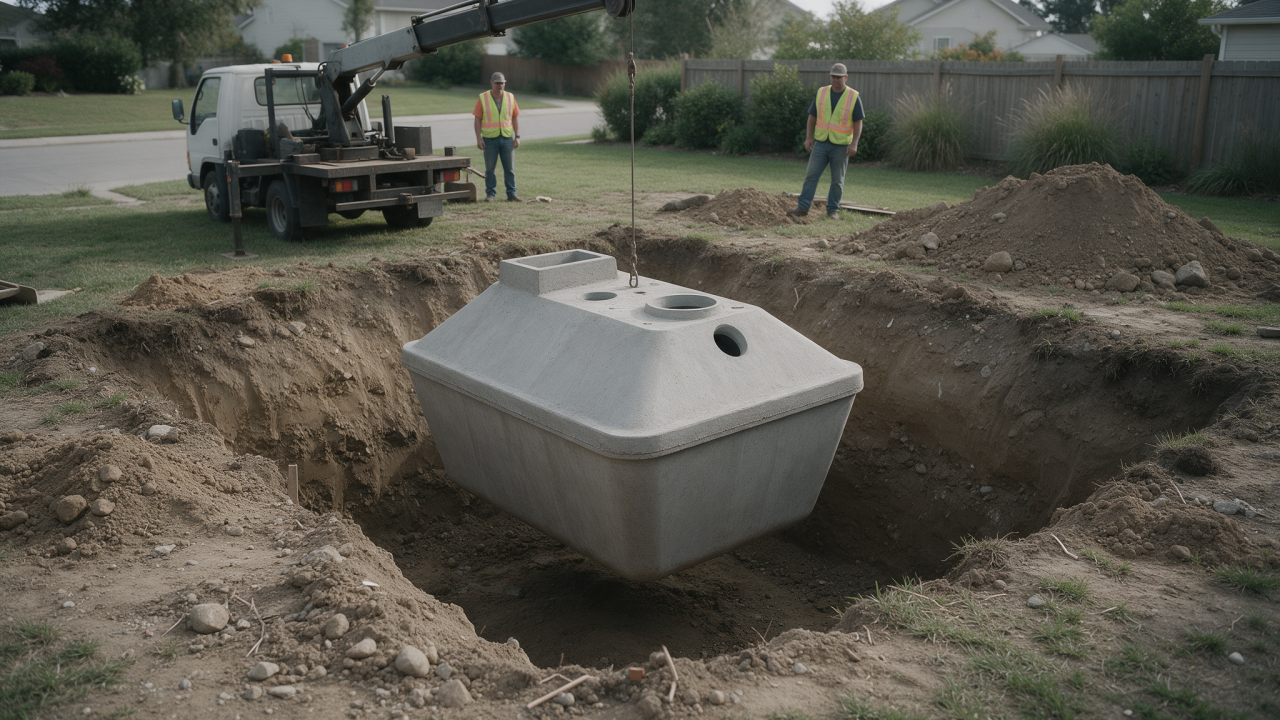
A septic tank’s material is not a style choice. Nebraska’s onsite wastewater rules accept concrete, fiberglass, high-density plastic, and fiber-reinforced plastic for a new tank, and ban metal and concrete block outright. Most states draw from a similar short list, which means the real decision is narrower than it looks, and it is usually made for you by what your county’s code allows.
- Four materials pass most state codes, concrete, fiberglass, high-density plastic and fiber-reinforced plastic
- Metal and concrete block are banned for new septic tank construction under Nebraska’s rules, because both fail over time
- Concrete tanks need an interior coating on any surface exposed to air, to keep the tank’s own gases from breaking it down
- A lighter tank is easier to install but easier to move, which is why installers pay closer attention to anchoring plastic and fiberglass tanks
What Your State’s Code Actually Allows
Under Nebraska’s Title 124 onsite wastewater rules, a septic tank “must be watertight and constructed of materials not subject to excessive corrosion or decay.” The acceptable list is concrete, fiber-reinforced plastic, high-density plastic, and fiberglass. Concrete block and metal are explicitly ruled out for any new tank, full stop.
That is not a Nebraska quirk. Codes in other states lean on the same handful of materials for the same reason: a septic tank holds raw, partly treated sewage for years at a time, and the materials that fail at that job get removed from the approved list state by state. Before you assume a material is an option, check your own county’s accepted-materials list, since it is the list that decides, not a supplier’s catalog.
Why Metal Tanks Disappeared
Metal septic tanks were allowed at one time. Nebraska Extension’s septic tank design guidance is blunt about what happened next: metal tanks “are not allowed now because they were found to be prone to rusting.” In some older installations, homeowners used buried 55-gallon steel drums as a tank, and those rusted out from the inside, where hydrogen sulfide gas and standing effluent attack bare metal fastest.
If a home inspection or a septic system type check turns up an old metal tank, it is a repair-or-replace decision, not a wait-and-see one. Nebraska’s guidance is explicit: replace a metal tank when you find one, if the system is in use or will be used. A corroded tank can fail from the inside without any visible surface sign, which is exactly why inspectors check tank material and condition separately, not just whether the system currently works.
Concrete: Heavy, Durable, and Still the Default
Precast concrete remains the material most installers reach for first. Its weight is an advantage underground: a full-size concrete tank is heavy enough that it generally stays put once it is set and backfilled, which matters in wet or unstable soil. Concrete also has decades of track record with local permitting offices, so there is rarely a question about whether an inspector will accept it.
The tradeoff is that concrete is not inert to what it holds. Nebraska’s rule requires that “all concrete interior surfaces of a tank that are exposed to air must be coated with bitumastic or similar protective compound beginning 3 inches below the normal effluent operating level.” That coating exists because the gas space above the liquid line, not the submerged concrete, is where sulfuric acid forms from hydrogen sulfide and slowly eats into uncoated concrete. A concrete tank installed without that coating, or with a coating that has failed, is a tank with a shortened life even though the outside looks fine.
Plastic and Fiberglass: Lighter, but Not a Downgrade
High-density plastic and fiber-reinforced plastic tanks do not corrode the way concrete can, and they do not need an interior coating, since there is no concrete surface for tank gases to degrade. That is a real maintenance advantage over the life of the tank. They are also far lighter than a concrete tank of the same capacity, which can mean a smaller crew and lighter equipment at delivery, especially on a site with limited truck access.
Fiberglass tanks sit between the two in practical terms: resistant to corrosion like plastic, but with more rigidity than thin-walled plastic under soil pressure. Fiberglass shows up often in aerobic treatment systems, where the tank also houses mechanical aeration equipment and a lighter, corrosion-resistant shell is easier to service.
The weight that makes plastic and fiberglass easy to install is also the reason they need more careful handling once they are in the ground, which is the subject of the next section.
The Flotation Risk With Lightweight Tanks
A buried tank sits in soil, and soil can become saturated with groundwater after heavy rain or in a naturally high water table. An empty tank, with nothing but air inside it, is far more buoyant than a full one, and a lightweight plastic or fiberglass tank in saturated soil can be pushed upward by that groundwater in a way a heavy concrete tank generally resists. This is why installers pay closer attention to how a lightweight tank is anchored and backfilled when the site has a seasonal or permanent high water table, and why a tank is at its most vulnerable to shifting right after it has been pumped out and sits temporarily empty.
If heavy rain is forecast right after a pump-out, ask your service company how they time it. An empty, lightweight tank in waterlogged soil is the scenario where flotation actually happens.
| Material | Accepted for new tanks | Needs interior coating | Weight class |
|---|---|---|---|
| Concrete | Yes | Yes, surfaces exposed to air | Heavy |
| Fiberglass | Yes | No | Light to medium |
| High-density plastic | Yes | No | Light |
| Fiber-reinforced plastic | Yes | No | Light |
| Concrete block | No, new construction | N/A | Heavy |
| Metal or steel | No, phased out | N/A | Heavy |
What a Permit and an Inspection Actually Check
A county permitting office is not grading tank material on durability alone. It is checking the tank model against its own accepted-materials list, confirming the tank is watertight, and, for concrete, confirming the coating is present where the rule requires it. A tank that is not on the county’s approved list can block a permit even if the material is legal in a neighboring state, which matters most at the two moments it actually gets checked: new installation, and a home sale where the system is part of the deal.
Material also is not the same question as system type. A cesspool stores and leaches waste without real treatment, regardless of what it is built from, which is a different problem from choosing between a concrete and a plastic tank that both treat wastewater the same way. Confusing the two during a sale or an inspection is a common, and avoidable, mistake.
No material wins outright. Concrete remains the default where codes allow a heavy, corrosion-prone-but-coated tank and the site can take the equipment. Plastic and fiberglass avoid the coating problem and the weight, at the cost of needing more careful anchoring in wet soil. Check your county’s accepted-materials list before you assume either option is available to you.
Can a septic tank be made of metal?
Not for new construction in states that follow Nebraska’s model, and generally not elsewhere either. Metal tanks were allowed decades ago but were phased out because they rust through from the inside. An existing metal tank found during an inspection should be treated as a replacement candidate, not left in place.
Why do concrete septic tanks need an interior coating?
The coating protects the concrete above the liquid line, where hydrogen sulfide gas converts to sulfuric acid and attacks uncoated concrete. Nebraska’s rule requires the coating starting 3 inches below the normal effluent level. A concrete tank without that coating, or with a failed one, degrades faster than its outside appearance suggests.
Is a plastic septic tank as strong as a concrete one?
Strength depends on what you are testing for. Plastic and fiberglass resist corrosion better than uncoated concrete, but neither is rated to support vehicle weight. No septic tank, regardless of material, is designed to have a car or heavy equipment driven or parked over it.
Does tank material change how often it needs pumping?
No. Pumping frequency is set by tank size and household wastewater volume, not by what the tank is made of. A plastic tank and a concrete tank of the same capacity fill at the same rate.
Can I replace a concrete tank with a plastic one?
Usually, if your county’s accepted-materials list includes plastic and the new tank is sized and installed to current code. The material swap itself is rarely the sticking point; the permit and inspection process is the same regardless of which accepted material you choose.
Why does an empty tank float more than a full one?
An empty tank is mostly air, which makes it buoyant in saturated soil the same way an empty boat floats higher than a loaded one. A full tank’s weight, plus its contents, works against that buoyancy. That is why flotation risk is highest right after a pump-out, before the tank refills.
Sources
- Nebraska Department of Environment and Energy, Tanks Fact Sheet (12-042), 2022
- University of Nebraska-Lincoln Extension, Septic Tank Design, water.unl.edu
SepticTankLab publishes general information for homeowners. It is not engineering, legal, insurance or medical advice, and it does not replace a licensed inspector. Cost figures are national ranges — get local quotes before you commit.


