
Most codes keep a septic tank at least 10 feet from the house and 50 feet from a drinking water well, though the exact numbers come from your state or county, not one national rule. So how far should a septic tank be from the house, exactly? It depends on which part of the system you mean: the tank itself, the drain field, or the property line next to it.
- 10 feet is a common minimum from the septic tank to an occupied building, sometimes reduced to 5 feet with local approval
- 50 feet is a typical minimum from the tank to a drinking water well, often 100 feet for the drain field
- 5 to 10 feet is a frequent minimum from the tank to the property line, though some counties require more
- These numbers come from state or county code, not from the tank’s manufacturer or any single national standard
How Far Should a Septic Tank Be From the House?
New Jersey’s statewide code sets a minimum of 10 feet between a septic tank and an occupied building, and that distance can drop to 5 feet only with special approval from the local health department. The drain field needs more room: 25 feet from the house, which can shrink to 15 feet for a section of the building built on a slab foundation. Other states use similar ranges, commonly 10 to 25 feet for the tank and 20 to 30 feet for the drain field, but the number that actually applies to your lot is the one your county health department enforces, not an average pulled from search results.
If you don’t already know exactly where your tank sits, start there before you measure anything else. Our guide to finding your septic tank walks through the cheapest methods first, and knowing how deep a septic tank sits tells you how much digging a setback correction would actually involve.
How Far a Septic Tank Must Be From a Well or Water Line
Wells get the widest buffer of any feature in the table. New Jersey requires 50 feet between a septic tank and a well, and 100 feet between the drain field and a well, the same scale of distance the U.S. EPA points to when it describes the kind of state-set setback that keeps wastewater bacteria and viruses out of drinking water. A pressurized water service line, by contrast, needs only 10 feet of separation from the tank, since it carries clean, pressurized water rather than groundwater that could seep in from outside.
| From | To a well | To the house | To the property line |
|---|---|---|---|
| Septic tank | 50 ft | 10 ft | 5 ft |
| Drain field | 100 ft | 25 ft | 10 ft |
A well that sits closer than your state’s minimum isn’t automatically contaminated, but it is a documented risk, and the risk is highest when the well sits downhill or downstream of the system. Don’t wait for a bad water test: call your county health department and ask what a closer well means for your specific setup.
Setbacks From Property Lines, Water Courses, and Pools
Property-line setbacks protect a neighbor’s ability to dig a well or build on their own land without inheriting your septic system’s buffer. New Jersey sets 5 feet from the tank and 10 feet from the drain field to the property line, with a 10-foot buffer from an in-ground pool for the tank and 20 feet for the field. A nearby stream, pond, or drainage course needs 25 feet from the tank and 50 feet from the drain field, since surface water carries contamination even faster than groundwater does.
Why These Distances Exist
Every one of these numbers traces back to the same problem: a septic tank and drain field release partially treated wastewater into the soil, and that wastewater still carries bacteria, viruses, and nutrients. The EPA’s guidance on septic systems and drinking water is blunt about it: contamination is less likely the farther a well sits from a septic system, and a well positioned downhill or downstream of one is at the highest risk no matter the distance involved. Distance from a building protects the foundation from the moisture a leaking tank or a saturated drain field can cause over time; distance from a property line keeps a future well, pool, or addition next door clear of your system’s buffer before it’s ever built.
How to Measure Your Own Distances Before You Dig or Build
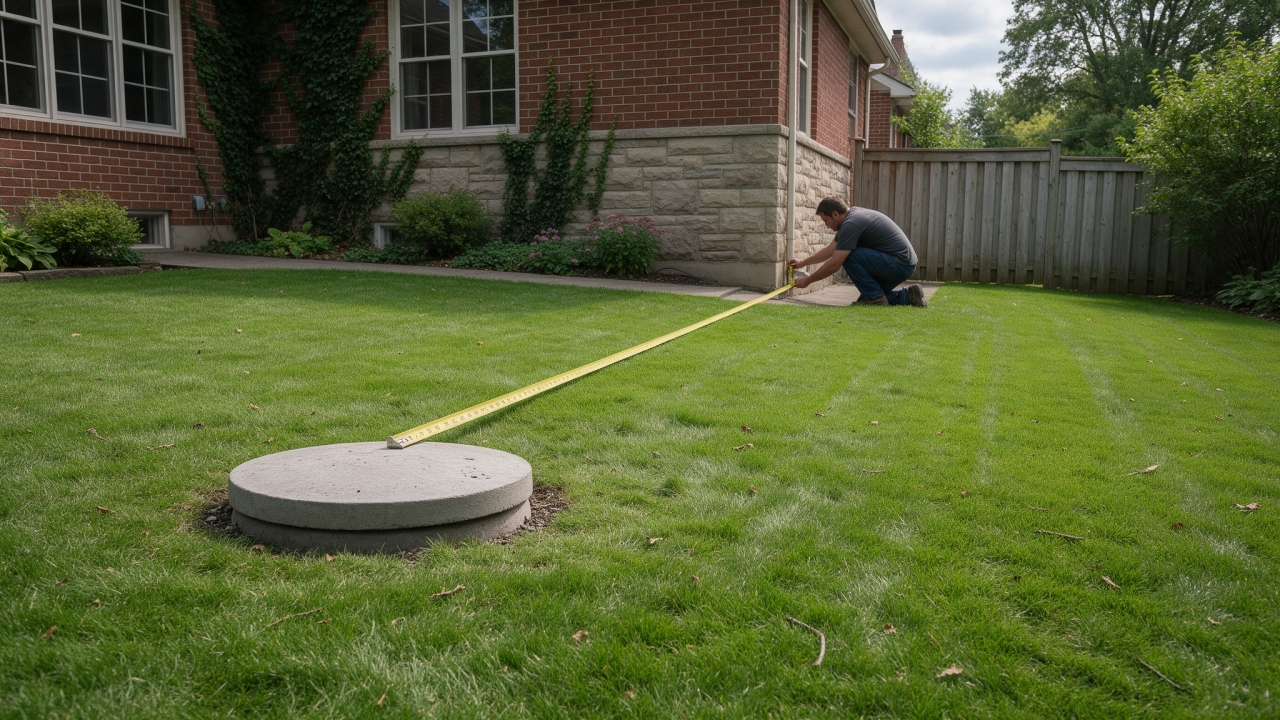
Measure in a straight line from the nearest edge of the component, not from its center: a setback to the “drain field” is measured from the outermost trench or bed, not the middle of the field. Locate your tank’s access lid and your wellhead first (our guide to finding your septic tank covers that), then run a tape measure between the two points rather than estimating by eye, since a few feet can be the difference between meeting code and needing a variance. Soil also matters: coarse, sandy, or fractured soil lets contaminants travel faster, and a percolation test is often what a county uses to decide whether your lot needs larger-than-standard setbacks before it issues a permit.
If Your Septic Tank Is Already Closer Than the Minimum
Older systems installed before current setbacks took effect are common, and most codes don’t force a retrofit just because the rules changed after installation. What they typically do require is disclosure when you sell, and often a variance or an engineered fix, such as a sealed riser, a pressure-dosed field, or a relocated well, if you’re adding a bedroom, a pool, or a new well near the existing system. Don’t assume a grandfathered setup is fine to ignore indefinitely: ask your county health department whether your specific distance triggers anything the next time you apply for a building permit nearby.
How to Find the Setback Rules for Your County
Start with your county or city health department, since most septic setbacks are enforced locally even when a state sets the statewide floor. Your original septic permit, if you can track it down, usually lists the exact distances an inspector measured and approved at installation. Call 811 before you dig to locate utility lines, but remember that 811 only marks utility-owned lines: it won’t mark your own well, your water service line, or a neighbor’s septic system, so measure those yourself or ask the health department for the property’s permit file.
A 10-foot gap from the house and a 50-foot gap from a well are common starting points, but your county’s permit record is the only number that actually governs your lot.
How close can a septic tank be to a house?
Many codes allow as little as 5 to 10 feet from the tank to an occupied building, though the drain field usually needs more room, often 15 to 25 feet depending on the foundation type.
What is the minimum distance a septic tank should be from a well?
50 feet is a common minimum under state codes such as New Jersey’s, with the drain field often required to sit even farther away, around 100 feet.
Can a septic tank be too far from the house?
There’s rarely a maximum distance, but placing a tank very far away can reduce the gravity flow the system relies on and may require a pump added later to move wastewater uphill.
Does soil type change the required setback?
Yes. Coarse, sandy, or fractured soil lets contaminants travel faster, and some codes let the local health authority increase the standard distances when that soil is present.
Who enforces septic setback distances?
Local or county health departments typically enforce the day-to-day distances, working from a state code that sets the statewide minimums they can tighten but rarely loosen.
Do setback rules apply to an existing septic tank, not just new ones?
Most codes apply the current setbacks to new construction and major alterations, not retroactively to an older tank, though a sale or a nearby addition can still require a review.
Sources
- U.S. Environmental Protection Agency, Septic Systems and Drinking Water, 2026
- New Jersey Department of Environmental Protection, Realty Improvement Sewerage Disposal Systems: Minimum Required Separation Distances, N.J.A.C. 7:9A-4.3, 2026
SepticTankLab publishes general information for homeowners. It is not engineering, legal, insurance or medical advice, and it does not replace a licensed inspector. Cost figures are national ranges — get local quotes before you commit.


